


If you’ve ever looked at your cast iron skillet and thought, “Is this supposed to look like that?” you’re not alone.
Seasoning can be one of the more confusing parts of owning cast iron. Maybe your skillet suddenly looks dull. Maybe the surface feels sticky. Maybe food that used to slide right out is starting to stick. Or perhaps you’re noticing dark and light spots across the cooking surface and wondering if you’ve somehow done something wrong.
The good news is that most cast iron seasoning problems are completely fixable. And even better, your skillet probably isn’t in as bad of shape as you think.
One of the biggest things we like to remind people is that seasoning doesn’t have to look perfect to work perfectly. Your skillet is going to change as you use it. It will develop darker spots, lighter spots, scratches, and little imperfections.
So instead of worrying about whether your skillet looks exactly the way you think it should, let’s talk about what you’re seeing, what’s happening, and what your next steps are.
First, What Exactly Is Seasoning?
Seasoning is the layer of polymerized oil that develops on the surface of your cast iron when oil is heated. Over time, those layers create the smooth, durable cooking surface that cast iron is known for.
It’s important to think of seasoning as something that develops over time rather than something you do once and never have to think about again. Every time you cook, clean, dry, and use your skillet, you’re contributing to that seasoning.
That also means your skillet probably won’t look exactly the same forever. In fact, it shouldn't.
A well-used skillet might be darker in the center, lighter around the edges, or have areas that look slightly different from one another. Those variations don't automatically mean something is wrong. What matters more is how the skillet feels and how it performs when you cook.
With that in mind, let’s get into some of the most common things you might notice.
Your Skillet Looks Dry, Dull, or Gray
If your skillet has started looking dry, faded, or gray instead of dark and slightly glossy, it may simply need a little more oil and regular use.
Cooking, cleaning, and especially high-heat cooking can gradually wear down the very top layer of seasoning. Try washing the skillet normally, drying it completely, and then rubbing a very thin layer of cast iron seasoning on it. A little goes a long way. In fact, one of the most common mistakes people make with cast iron is using too much oil.
After applying the oil, wipe the skillet again as if you were trying to remove all of it. You want the surface to feel conditioned rather than greasy.
From there, keep cooking. A little extra oil or fat during your next few meals can also help the seasoning on the surface to continue to develop naturally.
In many cases, your skillet doesn't need a dramatic fix. It just needs to be used.
Your Skillet Feels Sticky or Tacky
A sticky skillet is usually a sign that too much oil was used during seasoning.
It's an easy mistake to make. When you're trying to build seasoning, it seems logical that adding more oil would give you more seasoning. Unfortunately, that's not quite how it works.
When a thick layer of oil is heated, it may not fully polymerize. Instead of creating a hard, smooth layer, some of that oil can remain on the surface and leave your skillet feeling gummy or tacky.
The good news is that this is easy to correct.
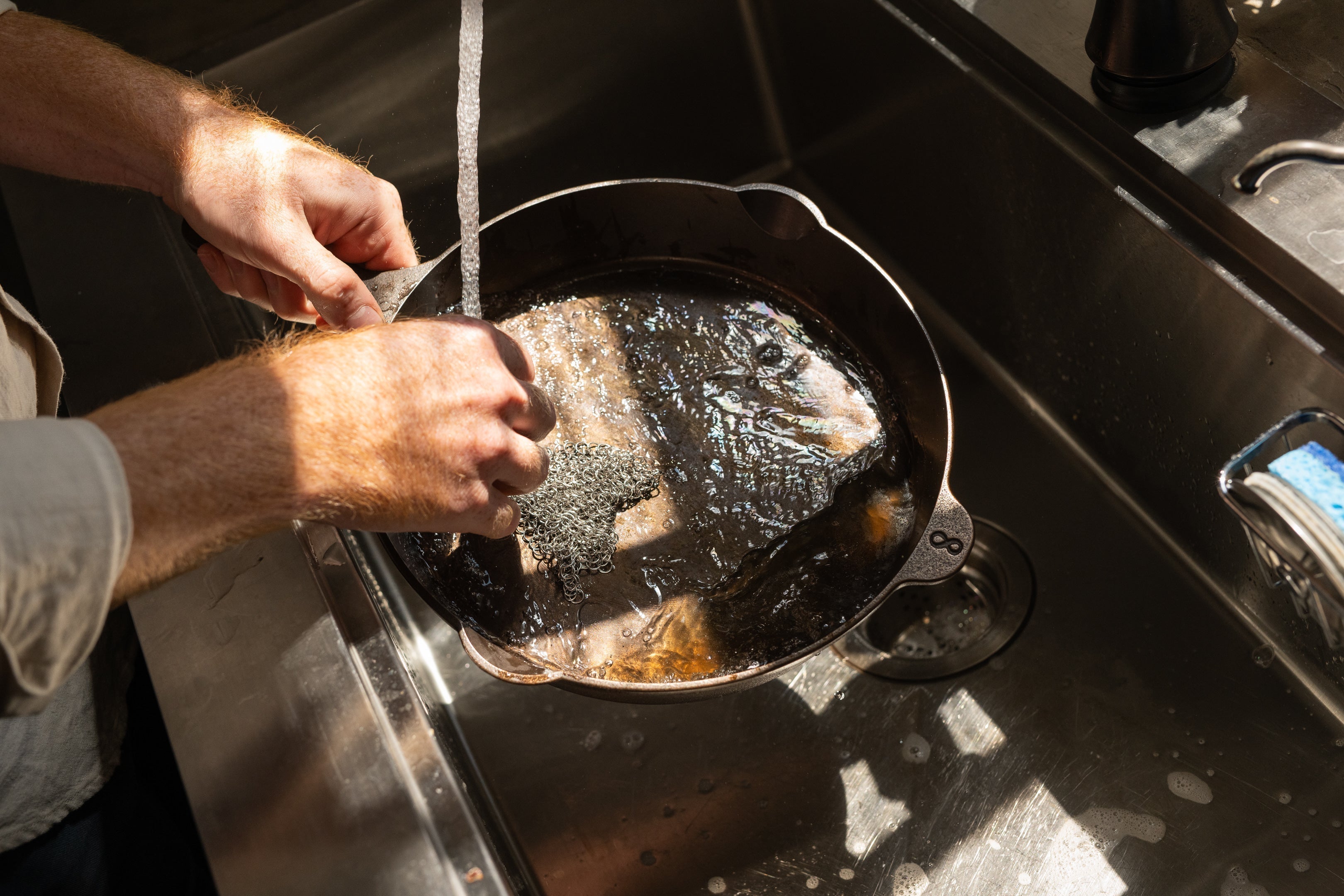
Give your skillet a good wash with warm water and a little dish soap, then use a chainmail scrubber to work over the sticky areas. Once you've removed the excess oil, dry the skillet thoroughly and apply a much thinner layer.
When it comes to seasoning, thin really is better. If you can clearly see a layer of oil sitting on the skillet, there's probably too much there.
And don't be afraid of the soap. A properly seasoned cast iron skillet can absolutely be washed with a little dish soap. Cleaning away food and excess oil isn't the same thing as destroying your seasoning.
Your Food Is Suddenly Sticking
This is probably the issue we hear about most often: “My cast iron used to be nonstick, but now everything is sticking.”
There are a few reasons this can happen.
Your seasoning may still be developing, you may not be using enough cooking fat, or the skillet may not be getting properly preheated. Sometimes, though, the food simply needs more time before you try to move it.
This is especially true with things like eggs, fish, chicken, and steak. When food first hits a hot skillet, it can naturally grab onto the surface. As it cooks and develops a crust, it often releases much more easily.
Try preheating your skillet gradually over medium or medium-low heat. Once it's warm, add your cooking fat and give it a moment to heat before adding your food. Then, and this is the hard part, leave the food alone for a little while. Sometimes what feels like sticking is really just food that isn't ready to move yet.
If you're consistently having trouble with sticking, keep cooking with a little more oil or fat and give your seasoning time to develop. Cast iron gets better through use, not overnight.
You’re Seeing Black Flakes or Bits Coming Off
Finding little black flakes on your cooking surface can be alarming, especially if you've always heard that seasoning is supposed to stay firmly attached to the skillet.
Usually, flakes or loose bits mean that something on the surface isn't properly bonded. This can happen when seasoning has been built up unevenly or when layers of residue have accumulated over time.
Start by giving the skillet a thorough scrub with warm water and a little dish soap. The goal is to remove anything that's loose or sitting on top of the actual seasoning.
Once you've cleaned it, dry the skillet completely and apply a very thin layer of oil.
If you're seeing a few tiny flakes here and there, you generally don't need to panic or strip your skillet down to bare iron. A good cleaning followed by regular cooking may be all it needs.
If large areas of seasoning are repeatedly peeling or flaking, however, it may be time for a more thorough reset.
Your Skillet Has Dark and Light Spots
If you look at your skillet and see a patchwork of dark, brown, gray, or black areas, don't automatically assume something is wrong.
Seasoning doesn't always develop evenly. Different parts of the skillet experience different amounts of heat, oil, moisture, and cooking. The center may see more direct heat and more food than the outer edges, so it's completely normal for the color to vary.
In many cases, the best solution is to simply leave it alone. Keep cooking, clean it after use, dry it thoroughly, and apply a light layer of oil when necessary. As you continue using the skillet, the surface will naturally change and develop.
And even if it never becomes one perfectly uniform shade of black, that's okay. Your skillet doesn't need to look perfect to make a great steak.
You’re Seeing Rust
Rust is one of the few things on this list that you definitely want to address, but seeing a little rust doesn't mean your skillet is ruined.
Rust usually forms when cast iron is exposed to moisture without enough protection from oil. Maybe the skillet was put away before it was completely dry. Maybe it sat in a damp sink. Maybe it was stored somewhere humid.
Whatever the reason, the fix is fairly straightforward.
Start by scrubbing the rust away with an appropriate abrasive scrubber until the loose rust has been removed. Wash the skillet, dry it completely, and then apply a very thin layer of oil. From there, regular cooking will help rebuild the seasoning.
Cast iron is incredibly durable, and a little rust is not the end of the road. It just means your skillet needs some attention before you get back to cooking.
Your Skillet Feels Rough or Bumpy
A rough or uneven surface can be caused by seasoning that has built up too thickly, unevenly, or by food and cooking residue accumulating on top of the seasoning.
Start with a good scrub. Warm water, a little dish soap, and a chainmail scrubber can go a long way toward removing residue that's sitting on top of your seasoning.
After cleaning, dry the skillet completely and apply a very thin layer of oil. Then use it.
Regular cooking can gradually help even out the surface, and you may find that what felt like a major problem was actually just some buildup that needed to be removed.
You Seasoned Your Skillet and Now It Looks Worse
This one is worth talking about because we've all been there.
You decide to give your skillet some extra attention. You carefully apply oil, heat it, follow all the instructions, and when you're finished, your skillet somehow looks worse than it did before.
It's blotchy. It's brown in some areas. There are streaks. It doesn't look anything like the perfectly black skillets you've seen online.
Before you strip everything down and start over, take a breath. Fresh seasoning doesn't always look beautiful. New layers can appear uneven, brown, gray, or streaky at first. That's okay. Seasoning develops over time, and what looks imperfect after one round of seasoning may look completely different after a few weeks of regular cooking.
If the surface feels hard and isn't sticky, the best thing you can often do is leave it alone and cook.
Don't Chase Perfect Seasoning
This may be the most important piece of cast iron advice we can give you: don't chase perfect seasoning.
Your skillet is a cooking tool. It's not supposed to stay frozen in the condition it was in when you bought it. It's going to change.
You're going to make mistakes. You'll probably burn something eventually. You might forget to dry it one night. You might use too much oil. You might notice a spot that looks different from the rest of the skillet. That's all part of cooking with cast iron.
Some of the best-looking skillets aren't perfectly uniform at all. They're dark in some places, lighter in others, and covered in the little signs of years of cooking. They look used because they are used.
The Best Way to Maintain Your Seasoning? Use Your Skillet.
The simplest thing you can do for your cast iron is also the most important: cook with it.
Make breakfast in it. Fry potatoes. Roast a chicken. Sear a steak. Bake cornbread. Make a pizza. Cook dinner on a Tuesday night when you don't feel like doing anything complicated.
You'll learn how hot it gets, how much oil you like to use, which foods release easily, and what the surface looks and feels like when it's at its best.
You'll see a lighter spot and know it just needs some cooking. You'll feel a little roughness and know it probably needs a good scrub. You'll see a little rust and know exactly what to do.
It isn't about maintaining a perfect finish. It's about building a cooking surface that gets better with time, one meal at a time.
What You'll Need
Whether you're restoring your seasoning or just keeping it in great shape, these are the tools we recommend:
- Cast Iron Seasoning — Our go-to for conditioning and rebuilding seasoning. A little goes a long way.
- Chainmail Scrubber — The best tool for removing stuck-on residue, rust, and excess buildup without damaging your skillet.
- Lancaster Cast Iron Skillets — If it's time for a fresh start, our skillets are made to last a lifetime — and get better with every meal.


Share:
Heavy vs. Lightweight Cast Iron: Does Weight Really Matter?
The Cast Iron Starter Kit: Everything a Beginner Needs