

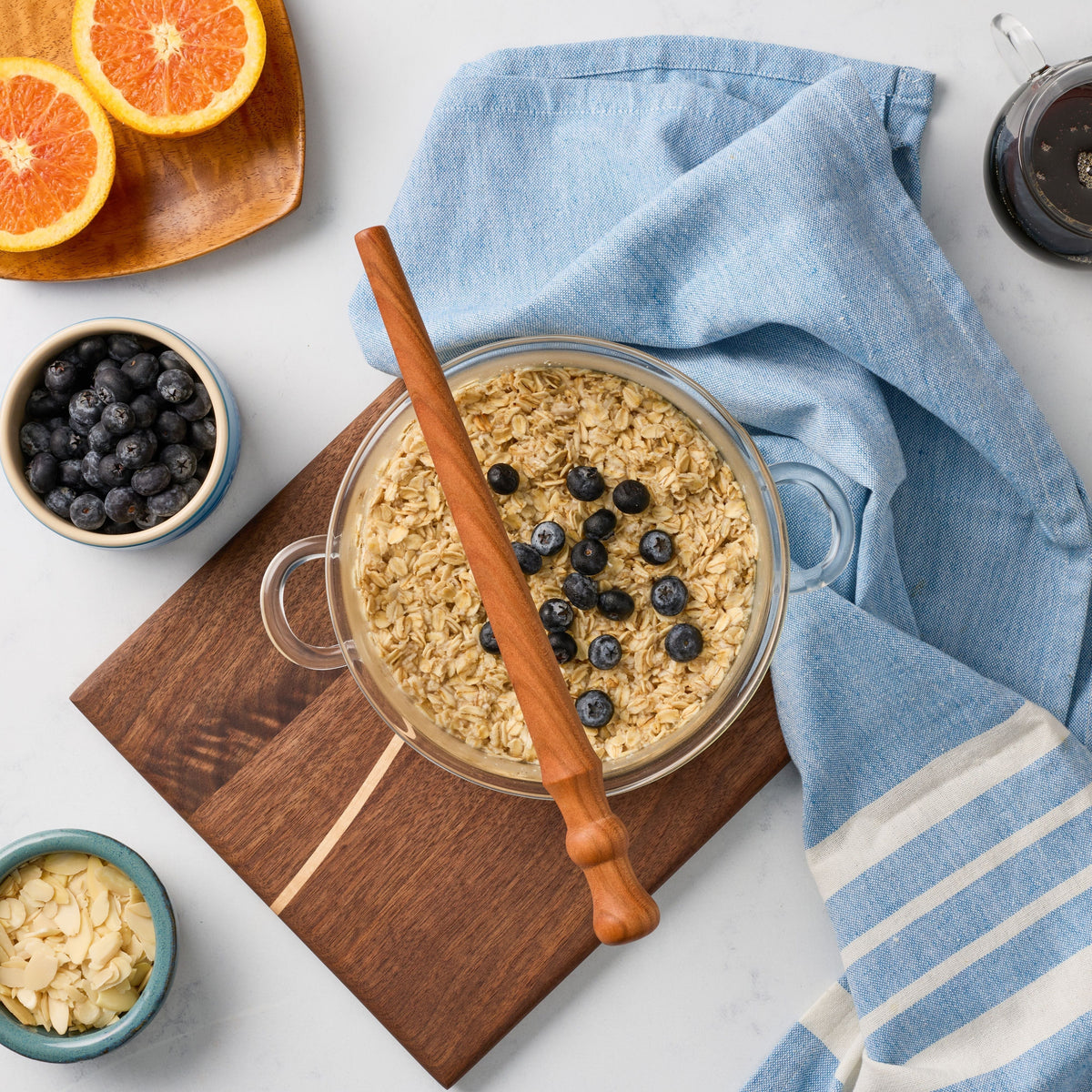
At first glance, a spurtle doesn't look particularly complicated. It is, essentially, a piece of wood shaped into a long, narrow cooking utensil. But this simple tool has a surprisingly long history, one that begins in Scotland and is closely tied to one of the country's most traditional foods: porridge.
For centuries, the spurtle was a familiar sight in Scottish kitchens. Its long handle and narrow, rounded end made it especially well suited for stirring oatmeal, but its usefulness didn't stop there. Different forms of the tool were also used for turning oatcakes and other foods on a hot cooking surface. Today, the spurtle has found its way into modern kitchens far beyond Scotland, where cooks have rediscovered just how useful a simple wooden utensil can be.
At Lancaster Cast Iron, we make our own versions of the traditional spurtle in our shop in Lancaster, Pennsylvania. While our kitchens may look very different from those of centuries-old Scotland, the basic idea remains the same: make a straightforward tool that works well and is built to be used.
Where Did the Spurtle Come From?
The exact origins of the spurtle are difficult to trace, and it would be misleading to give one specific year as the moment it was "invented." The Scots word spurtill appears in a 15th-century manuscript, while later Scottish sources provide clearer evidence of the utensil itself and its uses. The word also appeared in several forms over time, including spurtle, spurtel, spurtil, and spirtle.
That uncertainty is actually part of what makes the history interesting. Like many traditional kitchen tools, the spurtle probably developed gradually rather than appearing all at once. People were already cooking grains and other foods over fires and hearths, and a long wooden implement was a natural solution for stirring a thick pot without needing a large spoon.
By the 17th and 18th centuries, Scottish records clearly connect the spurtle with cooking. It was particularly associated with porridge, but historical definitions also describe versions of the tool being used for other foods as well. In other words, the spurtle was never simply a specialized "porridge stick." It was a practical kitchen utensil that could take on several jobs.
Why Was the Spurtle Used for Porridge?
To understand why the spurtle became so closely associated with porridge, it helps to understand the importance of oats in traditional Scottish cooking.
Oats were an important staple in Scotland for centuries. They were relatively inexpensive, filling, and well suited to the country's growing conditions. Porridge could be made with very few ingredients, making it a practical meal for households where food needed to be simple and dependable.
Cooking it, however, required some attention. Oatmeal becomes thick as it cooks, and stirring helped keep the mixture smooth and prevented it from sticking or becoming overly lumpy. A narrow wooden tool was particularly useful because it could move easily through the thick mixture without the resistance of a large spoon.
There was even tradition surrounding the way porridge was stirred. Historical Scottish sources record the practice of stirring "sun-wise," or clockwise, and the National Trust for Scotland notes that this was associated with good luck. Whether a cook followed the tradition for superstition or simply because that was the established way of doing things, the spurtle became an unmistakable part of Scottish porridge-making.
More Than Just a Porridge Tool
Porridge may be the food most strongly associated with the spurtle, but it wasn't the only thing it was used for. Historical Scottish dictionaries describe different forms of the utensil being used for stirring and turning foods, including oatcakes, scones, soups, broths, and other dishes.
The shape of the spurtle could vary depending on its purpose. Some were long and narrow, while others had a flatter end that made them useful for working with food on a hot plate or girdle. This is worth remembering when looking at modern spurtles because there isn't one single shape that represents every spurtle that has ever been made.
That's also part of what makes traditional kitchen tools so interesting. Their designs were often shaped by necessity rather than by a desire to create something that looked a certain way. A tool was made to solve a problem, and if that solution worked, people kept using it.
From Scottish Hearths to Modern Kitchens
For generations, the spurtle remained an ordinary part of cooking in Scotland. It wasn't necessarily treated as a specialty item or a historical object. It was simply a useful wooden utensil that belonged in the kitchen.
That has changed somewhat over time. Today, spurtles are often recognized as a distinctly Scottish kitchen tool, and they have also found an audience among cooks who appreciate traditional cookware and simple, durable utensils.
Part of the appeal is practical. A spurtle can still do the job it was originally designed for, but it can also be useful for plenty of modern cooking. It works well for stirring oatmeal, soups, sauces, and stews, and a wooden spurtle is gentle enough to use around the cooking surface of a pan without scratching it.
There is also something inviting about using a tool whose design hasn't needed much explanation or reinvention. You pick it up, put it in the pot, and start stirring.
Our Take on the Traditional Scottish Spurtle
At Lancaster Cast Iron, we wanted to preserve that simplicity while making the spurtle useful for today's kitchens. Our Scottish Spurtle takes inspiration from the traditional Scottish form, including its distinctive thistle-shaped handle.
We make our wooden spurtles here in Lancaster, Pennsylvania, using Pennsylvania hardwoods including Black Cherry. Each one is turned and sanded in our shop to create a smooth, comfortable cooking utensil.
The traditional shape is particularly well suited for stirring oatmeal, soups, stews, and broths, but there is no reason to limit it to those foods. Like the original spurtles, ours can become an everyday kitchen tool rather than something that only comes out for a particular recipe.
A Traditional Tool With a Modern Purpose
We also make several variations on the traditional design for cooks who want a little more versatility. Our Wooden Spurtle Set includes traditional and slotted designs, giving you different shapes for different cooking tasks. The slotted version can be useful for stirring, whisking, mixing, and working with ingredients where a little more separation is helpful.
For larger pots and bigger batches, our Large Wooden Spurtle offers a longer design, while our 10-inch Wooden Spurtle is a compact option for everyday cooking, and a great sourdough starter mixing utensil.
Each one is handmade in Lancaster, Pennsylvania from solid hardwood. There are no complicated mechanisms or unnecessary parts. Just wood, careful craftsmanship, and a design that has already proven itself over generations.
Why the Spurtle Has Stuck Around
Kitchen trends come and go. Tools change, materials change, and new gadgets appear all the time. Yet some of the oldest cooking tools remain useful because their designs were already doing what they needed to do.
The kitchens of historic Scotland and the kitchens of modern America have plenty of differences, but the basic act of stirring a pot hasn't changed very much. Whether you're making a traditional bowl of Scottish oatmeal or stirring a pot of soup for your family, you still need something comfortable, durable, and easy to control. It simply does its job well.
From Scottish hearths to modern American kitchens, the spurtle has traveled a long way without losing the qualities that made it useful in the first place. At Lancaster Cast Iron, we're proud to carry a small part of that tradition forward, making our own wooden spurtles right here in Lancaster, Pennsylvania.
Shop Lancaster's Handmade Spurtles
If you'd like to bring a little Scottish kitchen history into your own kitchen, explore the Lancaster Cast Iron Spurtle Collection. You'll find our Scottish Spurtle, slotted spurtles, larger cooking spurtles, and handmade sets. A centuries-old idea, made for the way we cook today.
Share:
Cast Iron Cookware: American Foundries to the Modern Kitchen
Can You Use Wooden Utensils on Cast Iron Cookware?